

Unfollow.
The first thing I ever unfollowed was a lie dressed up as education.

Toledo, Ohio. 1974. Four years after Kent State. Sixty miles away. I was eighteen years old — and the ground under every institution in America was still smoking.
Nixon was gone. Vietnam was ending in disgrace. Four students had been shot dead by the Ohio National Guard on an Ohio campus for asking the wrong questions. Neil Young wrote the song. We all knew every word.
“Tin soldiers and Nixon coming. We’re finally on our own.”
I didn’t arrive at Toledo as a blank slate waiting to be filled. None of us did. We arrived already knowing that the official story was a lie. That institutions protected themselves first. That the loudest voices were not the wisest ones.
That the banking model — deposit the approved version of reality into passive students, collect compliance, call it education — was not just intellectually bankrupt.
It was morally dangerous.
* * *
I grew up on Corey Road in Sylvania, Ohio. Down the street from the country club. Large homes, large yards, large certainties. The social architecture was perfectly legible: the it crowd, the socials, the greasers, the jocks, the frocks — the kids who moved between the jocks and the freaks depending on the day. Most of the people in my ecosystem were getting their drama and their reality from the television set in the living room.
We were heading across the line to Detroit.
Motown. The MC5. The politics bleeding through every frequency. A city on fire — literally, 1967, the uprising that left 43 dead and 2,000 buildings destroyed — still smoking in the culture when we were crossing that border looking for something the country club couldn’t give us. The movements weren’t abstract. They were the air. The marches, the music, the slow dawning understanding that the world being handed to us — the Corey Road version, the country club version, the television version — had been constructed by people with interests that were not our interests.
CSNY wasn’t background music. It was a framework for understanding power.
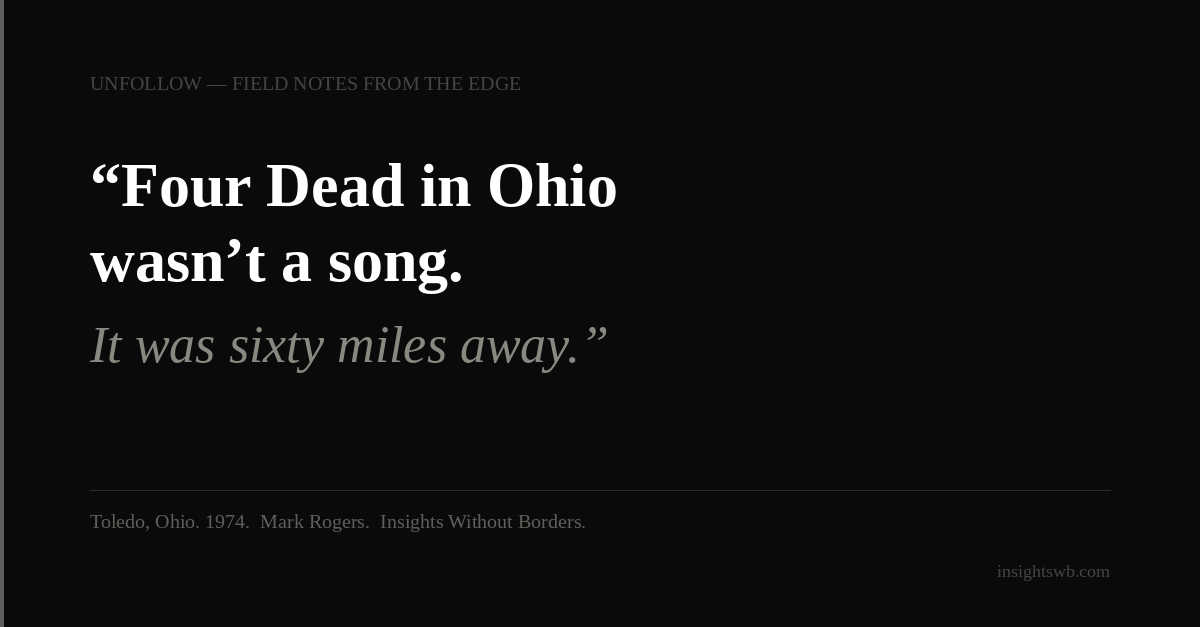
Four Dead in Ohio wasn’t a song. It was sixty miles away.
And then I walked into one of seven experimental education programs in the country — and found Paulo Freire.
“Pedagogy of the Oppressed had landed in English four years earlier. On Ohio campuses in 1974 it wasn’t philosophy. It was an autopsy.”
* * *
THE DISCOVERY.
Freire named what Kent State had shown: that the banking model of education — fill the vessel, demand compliance, punish resistance — was the operating system of institutions that feared conscious human beings.
I was also reading de Bono. Gagné. Encountering individualized instruction, competency-based teacher education, instructional systems design as it was being invented in real time. The entire architecture of how humans learn was being rebuilt from the ground up.
And somewhere in all of it — I found Magoroh Maruyama.
* * *
THE FOUNDATION THEY NEVER CITED
A Japanese-American scholar. A man who had lived through internment — the American government’s own banking model applied to an entire people: you are what we say you are, you go where we say you go, your perception of your own reality is irrelevant.
Maruyama built something in response to that. He called it Mindscape.
Not an attitude. Not a binary. The epistemological architecture through which individuals and communities perceive, construct, and inhabit reality. The sociology of thinking itself. The framework that explains not just what you believe — but what you are structurally capable of believing at all.
Maruyama identified distinct mindscape typologies — not personality types, not attitude categories, but epistemological structures that determine how entire communities construct reality differently from one another.
His work drew on cybernetics, anthropology, and systems theory. It was never going to fit on a poster.
Over the following decades I synthesized it with the psychodynamic tradition — Zaleznik, Levinson, Kets de Vries — with social anthropology, with the sociology of knowledge as mapped by Mannheim and Zerubavel.
The result was a methodology that could go where fixed/growth mindset cannot: into the preconscious architecture that actually governs human behavior in organizations.
“In 1974, in Ohio, four years after Kent State, that was not an abstract academic proposition. That was the most urgent idea I had ever encountered.”
* * *
FIFTY YEARS. NOT A SLIDESHOW.
I spent the next fifty years with it. Not writing a book about it. Not building a workshop around it. Not turning it into a poster or a two-column chart or a TED Talk or an airport bestseller.
Building a methodology. One rigorous enough to actually do what it claimed. To go below attitude, below behavior, below the surface interventions that organizations mistake for transformation — into the preconscious architecture that actually governs how people lead, relate, create, and get stuck.
In 2006, Carol Dweck published Mindset.
I watched it ascend not because the evidence was strong — it wasn’t — but because it was simple, sellable, and required nothing of the people selling it. It gave the industrial-academic complex exactly what it needed: a binary that felt profound, could be explained in twenty minutes, and generated decades of consulting revenue.
Fixed mindset. Growth mindset.
A fortune cookie with a better publicist.
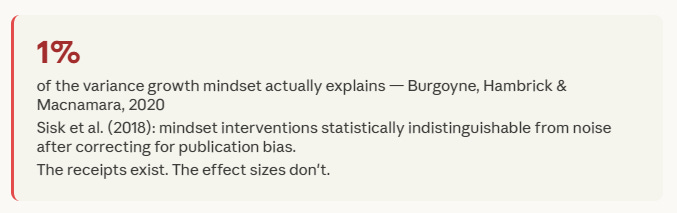
The field had already solved the problem it claimed to address. Weiner in 1972. Bandura in 1977. Rotter in 1966. And behind all of them, Maruyama in the 1960s — whose work was never going to make the airport bookstore because it demanded that you actually think.
But I didn’t need the replication crisis to tell me.
I could see the foundation from 1974.
* * *
THE AI MOMENT
In 2015, the work was formalized under Insights Without Borders. Truth tellers and mind shifters. Not because it’s a good tagline. Because it’s an accurate description of what the work requires.
And now — with AI amplifying every existing mindscape, expanding blind spots or dissolving them depending entirely on the perceptual architecture underneath — the framework built in the shadow of Kent State, informed by Freire and Maruyama and fifty years of synthesis, is more necessary than it has ever been.
Because AI does not build new perceptual architecture. It accelerates existing architecture — whatever mindscape a leader, a team, or an organization already inhabits. The blind spots get faster. The limitations get more efficient. The preconscious patterns that were already running the show now run it at scale.
“AI does not transform your mindscape. It amplifies it. Feed it to a leader whose architecture is defined by scarcity and fear — and you get faster, more efficient scarcity and fear.”
The world is finally asking the question Maruyama posed in the 1960s.
What is the actual architecture of how you perceive reality — and what does it make invisible to you?
That is not a growth mindset question.
That is the only question that has ever mattered.
* * *
THE REAL WORK
At IWB we call ourselves truth tellers and mind shifters.
That language is not branding. It is a description of what the work actually requires.
Truth telling means surfacing Mokita — what organizations already know but have agreed not to say, and what they cannot yet see at all. Mind shifting means working at the level of perceptual architecture itself. Not reframing. Not rebranding. Restructuring the inner landscape from which everything else flows.
This is not coaching. It is not training. It is not a framework you adopt on a Monday and forget by Friday.
It is the work of fifty years — synthesized, sharpened, applied to real leaders in real organizations facing real stakes.
One question worth sitting with before you scroll past:
What is your mindscape actually built for?
Unfollow exists because the loudest voices still aren’t the wisest ones.
And some of us have known that since Ohio. Since 1974. Since four dead on a campus sixty miles away proved that institutions will protect the official story at any cost.
The work was always going to take fifty years.
It was always going to arrive exactly now.
Unfollow the noise.
Follow the architecture.
Mark Rogers
Managing Partner, Insights Without Borders
insightswb.com